

 Português pt
 Español es
 العربية ar
 বাংলা bn
 Deutsch de
 Filipino fil
 Français fr
 हिन्दी hi
 Bahasa Indonesia id
 Italiano it
 Русский ru
 Svenska sv
 ไทย th
 Türkçe tr
 Tiếng Việt vi
 简体中文 zh
What Dark Pools Are and How They Affect Visible Market Liquidity
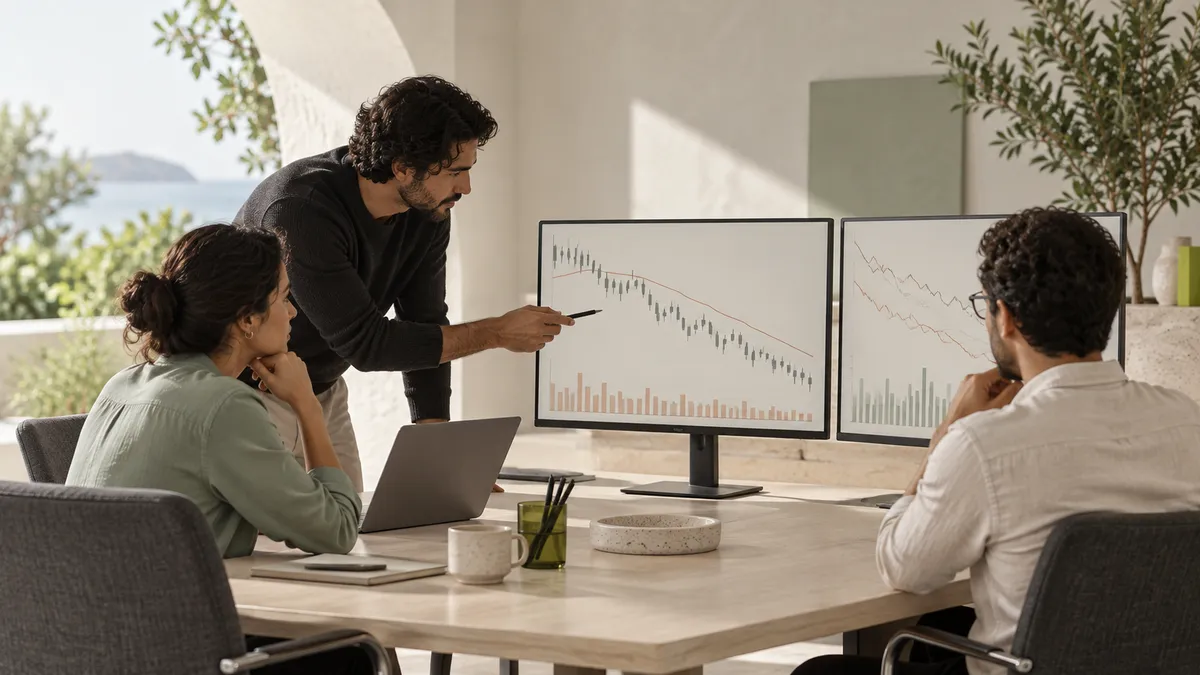
Not all trading of stocks and other assets happens on open exchanges that any investor can watch in real time. A significant share of globally traded volume goes through private trading venues, known as dark pools — called that because the orders there don't appear publicly before being executed.
What a dark pool actually is
A dark pool is a private trading platform, operated by banks, brokers, or specialized firms, where institutional investors — pension funds, asset managers, large investment funds — can trade large blocks of shares without exposing the order to the public market before execution. The trade only becomes public after it's completed, usually with a small reporting delay.
Why an institution prefers trading this way
Imagine a fund that needs to sell a block of 2 million shares of a company. If this entire order showed up at once on a public exchange's order book, the market would likely react before execution was even complete, driving the price down as other participants noticed the selling pressure — an effect called market impact. By trading in a dark pool, the fund can execute this large volume with counterparties that are also institutional, without revealing its intention in advance and without moving the price against itself before finishing the trade.
The effect on transparency for the small investor
Since a portion of traded volume doesn't appear on the public order book before execution, the price and volume visible on open exchanges represent only a slice of that asset's real market activity. That means a small investor, looking only at the open exchange's volume, may be seeing an incomplete picture of the real supply and demand for that stock at a given moment — without that, by itself, representing any wrongdoing.
Regulation and limits of this type of trading
Dark pools operate under regulation from each market's supervisory bodies, with specific rules on trade reporting, minimum lot size, and the deadline for making the trade public after it's completed. These rules exist precisely to balance the benefit of reducing market impact on large orders with the need to maintain a minimum level of transparency for the market as a whole.
It's not a conspiracy theory, it's a piece of the system
It's common to come across the idea that dark pools exist to "hide" big players' moves against the small investor. In practice, the mechanism exists to solve a real, recognized problem — the market impact of very large orders — within a regulated, reported framework, not to operate outside the law. Small investors don't have direct access to these venues because they're designed for large-scale institutional trading, not because there's an intention to specifically harm them.
What this changes in practice for retail traders
Knowing dark pools exist helps explain certain price moves that seem disproportionate to the volume visible on the open exchange — part of the real activity simply wasn't visible until the trade was reported. This reinforces the importance of not drawing definitive conclusions solely from a single exchange's volume, especially on large-cap assets where institutional trading is more intense, and of treating volume and order-flow readings as partial data, not the market's complete picture.
What to watch when volume seems not to match the move
When an asset moves significantly with no corresponding volume visible on the open exchange, it's worth considering the possibility that relevant trading happened outside the public venue before being reported. That doesn't change the decision to trade or not, but it avoids the rushed conclusion that "the market moved for no reason" — often the reason existed, it just wasn't visible at the moment the move happened. Following periodic aggregate volume reports, when available, helps get a somewhat more complete view than just the real-time order book. This habit is especially useful for those basing decisions on volume analysis: understanding that the displayed number is partial, not the total traded in the market, avoids mistaken conclusions drawn from incomplete data.
Practice before you risk. Open your Astron account and test your ideas on the demo account with R$ 10,000 in virtual funds.
Create free account