

 Português pt
 Español es
 العربية ar
 বাংলা bn
 Deutsch de
 Filipino fil
 Français fr
 हिन्दी hi
 Bahasa Indonesia id
 Italiano it
 Русский ru
 Svenska sv
 ไทย th
 Türkçe tr
 Tiếng Việt vi
 简体中文 zh
Price Gaps: Why They Happen and Why They Matter
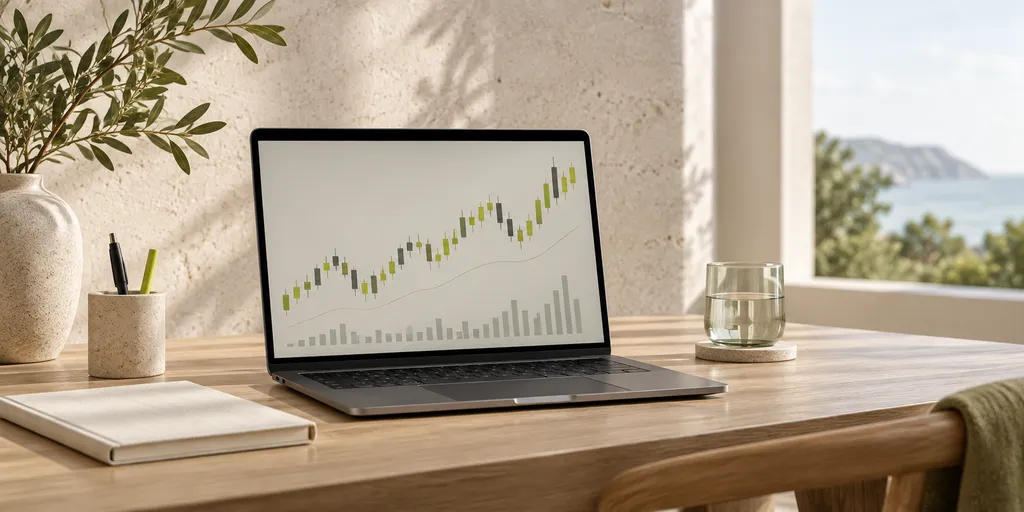
A gap happens when an asset's opening price sits noticeably far from the previous period's close, with no trading recorded in between. On the chart, it shows up as an empty space between one candle and the next — hence the name, a "gap" or "void".
Gaps are more common in markets that close for a period (stocks, for example, which don't trade 24 hours) than in markets that run continuously, like much of forex. Understanding why they happen helps you handle the risk they carry better.
Why the price jumps instead of walking
Outside regular trading hours, news keeps happening: quarterly earnings, interest rate decisions, economic data, political events. Since no one can trade immediately while the market is closed, all that information piles up and gets processed at once when the session reopens. The opening price already reflects that new information, even without any trading happening along the way — hence the jump.
A simple example: an asset closes at R$ 68.00. After the close, the company reports quarterly earnings well above expectations. On the next session, the asset opens at R$ 74.50, with no trades recorded between R$ 68.00 and R$ 74.50 — that gap is the space in between.
The four types of gap
- Common gap: happens within a trading range with no clear trend, usually due to low volume or lower-impact news. It tends to fill quickly, meaning the price returns to trading within the previous range in a short time.
- Breakaway gap: shows up at the start of a new move, often breaking out of a long consolidation range, and usually comes with high volume. It signals the start of a trend, not just noise.
- Continuation (or runaway) gap: appears in the middle of an already ongoing trend, reinforcing the existing move. It usually indicates the trend still has strength.
- Exhaustion gap: appears near the end of a prolonged move, often as the last push before a reversal. Unlike the continuation gap, this one tends to be followed by a quick fill of the gap itself.
Why this matters for traders
Gaps directly affect risk management in two practical ways. The first is the stop-loss itself: a stop order, on paper, is executed at a specific price, but if the market opens with a gap beyond that level, execution can happen much further away than planned — a problem known as slippage. A stop meant to limit the loss to R$ 2.00 per share can, in a gap scenario, result in a loss of R$ 5.00 or more, because there was no trading at the stop's exact price.
The second way is the calculation of volatility indicators themselves, like the ATR, which need to account for gaps to avoid underestimating the asset's real movement — that's exactly why the True Range calculation uses the distance between the previous close and the current high or low, not just the candle's internal range.
The concept of gap fill
A frequently observed behavior is the price coming back to fill the gap, trading again within the price range that was skipped at the open. This doesn't always happen, nor within a predictable time frame, but it's common enough to become a reference for some traders: some treat the fill as a target for a trade against the gap, especially on common and exhaustion gaps, which statistically tend to close more often than breakaway and continuation gaps.
Handling gaps in practice
Avoiding surprises from gaps is more a matter of risk management than prediction. This includes sizing positions considering the stop may not be executed at the exact defined price, avoiding excessive leverage on assets that tend to open with relevant gaps (around quarterly earnings, for example), and recognizing the type of gap before deciding whether it represents an opportunity or just noise to ignore. As with any out-of-the-ordinary market situation, extra risk management care pays off more than trying to guess the direction of the next gap, especially on assets and dates where the chance of a relevant news event is known in advance.
Practice before you risk. Open your Astron account and test your ideas on the demo account with R$ 10,000 in virtual funds.
Create free account